
The Diane Middlebrook and Carl Djerassi Visiting Professorship Lectures

Introduction
The Diane Middlebrook and Carl Djerassi Visiting Professorship was generously endowed by Carl Djerassi (Professor Emeritus, Stanford University and inventor of the contraceptive pill) in honour of his late wife Diane Middlebrook (Professor Emerita and Head of Gender Studies, Stanford University). The Diane Middlebrook and Carl Djerassi Visiting Professors each give a high profile public lecture on a gender related topic.
Previous Visiting Professorship Lecture recordings
Diane Middlebrook and Carl Djerassi Visiting Professorship Lecture: Lent 2026
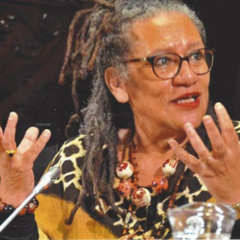
Professor Gloria Wekker, Professor Emerita in Gender Studies, Utrecht University is the Diane Middlebrook and Carl Djerassi Visiting Professor for the Lent term 2026.
Professor Wekker’s Visiting Professorship Lecture, ‘Still crazy after all those years; Revisiting Intersectionality ' was held in the Yusuf Hamied Theatre, Christ’s College, Cambridge on Wednesday 11 March. Our sincere thanks to Professor Wekker and all contributors for an inspiring lecture, which was followed by a Q&A and drinks reception.
Lecture abstract:
In my presentation, I will outline a critical picture of relevant (inter)national contexts in which the discipline of Gender Studies operates, in our current time. I will address two central issues. First, I will turn to the emergence in the past two decades of relatively new, bottom-up conceptualizations of gendered and sexual positionings, in conjunction with race. The development of these bottom-up terms has taken place against the backdrop of the so-called “anti-gender ideology”, global representatives of a patriarchal, white superiority-based order, which wants to undo everything that has been achieved by progressive movements, during decades of struggle.
Second, I will reflect on a Dutch “feminist classic”, entitled “Caleidoscopische Visies”/ Kaleidoscopic Visions (2001/ 2024), first published in 2001, under the editorship of two colleagues and me. (Jouwe, Botman and Wekker). Until recently, it was the first and only publication in the Dutch-language area dedicated to intersectionality. Which lessons can be learned from the history of the book, from its publication and reception in 2001 to its latest incarnation in 2024? What, ultimately, does it tell us about power relations within the discipline of Gender Studies in The Netherlands?